
Tuition-free, no Japanese required to apply, and — unlike several scholarships on this site — no requirement to return home afterward. Here's how the two application routes actually work.
Most fully funded scholarships come with a catch: some minimum work-experience requirement, a mandatory return to your home country for years afterward, or a punishing language test before you can even apply. MEXT — the Japanese government's scholarship program — sidesteps most of that. There's no Japanese language requirement at the application stage, no IELTS/TOEFL requirement for many tracks, and critically, no formal obligation to return home after you finish.
It's also one of the only major scholarships on this site that funds undergraduate study alongside Master's and PhD, similar to what we covered in our Türkiye Bursları guide. But MEXT has a genuinely confusing structure — two separate application routes with different processes — so this guide walks through exactly how each one works.

What Is the MEXT Scholarship?
MEXT stands for Japan's Ministry of Education, Culture, Sports, Science and Technology. Administered with support from the Japan Student Services Organization (JASSO), it funds international students across nearly every field — from social sciences to engineering to medicine — at Japanese universities, with genuinely no restriction on academic discipline.
What It Covers
- Full tuition at your Japanese university
- A monthly stipend, roughly ¥143,000–145,000
- Round-trip airfare to and from Japan
- A free introductory Japanese language course before your program begins
The Two Application Routes
This is where most first-time applicants get confused, so it's worth understanding clearly before you plan anything.
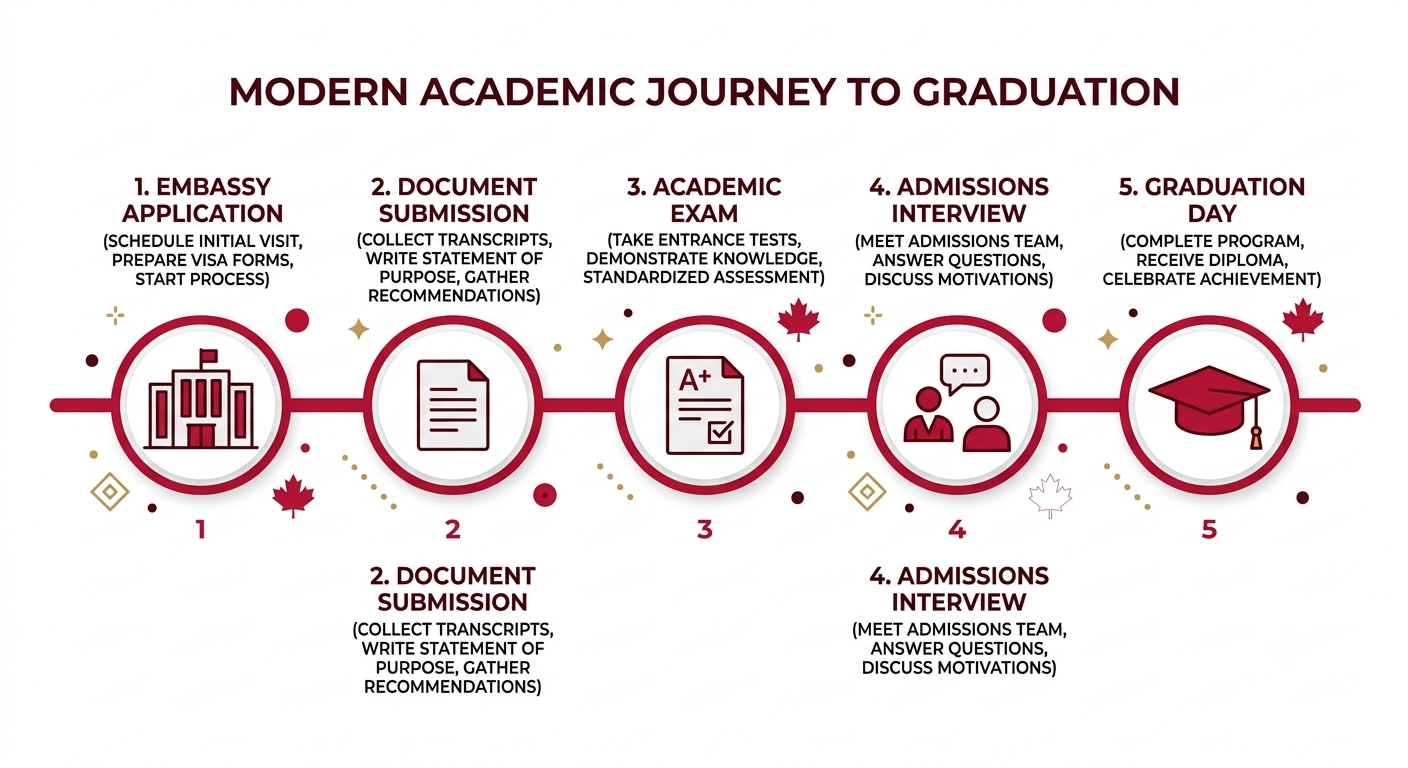
Embassy Recommendation
You apply directly through the Japanese embassy or consulate in your home country. This is the route most first-time applicants use — no prior contact with a Japanese university needed.
Process: written exam + interview at the embassy, then MEXT conducts a second screening centrally.
University Recommendation
You apply directly to a Japanese university, which then nominates you to MEXT. This route generally requires you to have already contacted a prospective supervisor.
Deadlines run later in the year — typically September 2026 through January 2027 for the following year's intake, varying by university.
MEXT — Typical Yearly Timeline
Use this as your planning framework, and always confirm your country's exact dates with your local Japanese embassy — they vary noticeably by country.
Who Can Apply? (General Eligibility)
- You hold the nationality of a country with diplomatic relations with Japan (Japanese nationals are not eligible)
- Bachelor's applicants: aged 17–25, completed the equivalent of 12 years of school education
- Master's/PhD applicants: under 35, hold or are completing a relevant degree (16 years of education for Master's, 18 for PhD)
- You're not currently holding, or under consideration for, another Japanese government scholarship
- Most embassies expect a solid undergraduate academic record — commonly cited around 80% or a 3.0/4.0 GPA equivalent as a realistic working floor
Where to Apply
Your Local Japanese Embassy Website
Every embassy publishes its own country-specific MEXT guidelines, forms, and deadline. Search "[your country] Japanese Embassy MEXT scholarship" to find yours.
studyinjapan.go.jp →JASSO Study in Japan Portal
Search Japanese universities and programs, and find each institution's specific University Recommendation application process and deadline.
jasso.go.jp →How to Apply — Step-by-Step (Embassy Route)
Search for the Japanese embassy or consulate covering your country and locate its current MEXT scholarship announcement.
Undergraduate, Research Student (Master's/PhD), or Specialized Training College — each has its own form and requirements.
Application form, academic transcripts, degree certificates, a field-of-study or research plan, and recommendation letters.
Applications are submitted directly to the embassy, not to MEXT in Tokyo.
Only shortlisted applicants are invited — usually in June or July.
The embassy recommends candidates to MEXT, which conducts its own final review.
Typically announced between January and March for an April start.
Documents You'll Need
- Completed application form (embassy-specific version)
- Academic transcripts and degree certificates, translated into English or Japanese if needed
- A field-of-study or research plan (this matters far more than most applicants assume — treat it as your most important document)
- Academic recommendation letter(s)
- Passport-style photos
- PhD/Master's applicants under the University Recommendation route: a Letter of Provisional Acceptance from a Japanese professor
Common Mistakes That Get Applications Rejected
- Applying through the wrong route — attempting Embassy Recommendation after contacting a professor, when University Recommendation would fit better, or vice versa
- Missing your specific embassy's deadline, which can differ from other countries by weeks
- Writing a generic field-of-study statement with no connection to a specific Japanese research strength
- PhD/University Recommendation applicants reaching out to professors too late to secure a Letter of Provisional Acceptance
- Assuming Japanese language ability is required at application — it isn't, but not addressing your language plan at all can weaken a Research Student application
Should You Apply?
If you want a fully funded degree with genuinely broad subject coverage, no return-service requirement, and — for undergraduate applicants especially — one of the few scholarships open at that level worldwide, MEXT is well worth the embassy paperwork. Start by identifying your local embassy's typical deadline window now, so you're not searching for it for the first time during application season.
Have any thoughts?
Share your reaction or leave a quick response — we’d love to hear what you think!
-
 0
0
-
 0
0
-
 0
0
-
 0
0
-
 0
0
-
 0
0