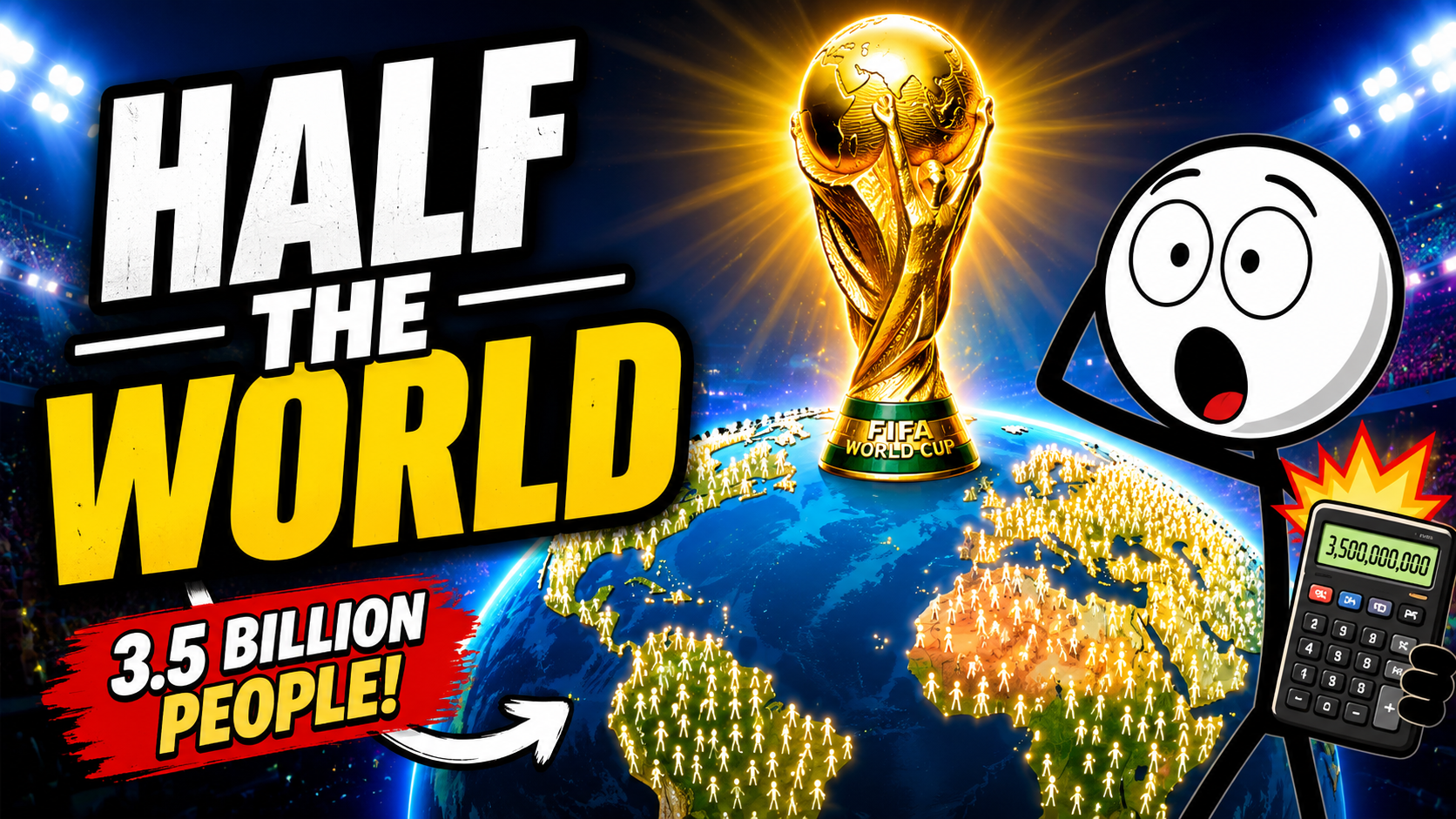
At any given moment during the FIFA World Cup, approximately 3.5 billion people—nearly half of the entire human race—are staring at the same ball. To put that in perspective, the Super Bowl is a regional picnic and the NBA Finals are a niche interest by comparison. This isn’t a sporting event; it’s a temporary cessation of global reality. If you’re sitting there thinking “it’s just football,” you aren’t just missing the point—you’re missing the largest collective human act in history. This is something much, much bigger.
A Reach That Defies Logic
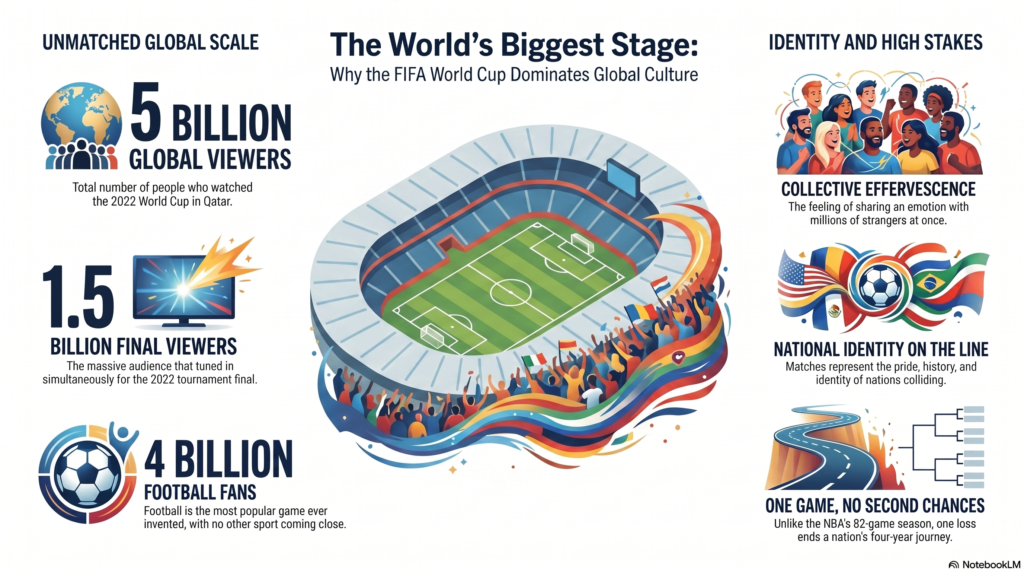
The foundation of this global dominance is the sheer, egalitarian simplicity of the game. Football is the most popular sport ever invented because it requires nothing but a ball and a patch of dirt. This low barrier to entry has cultivated a fan base of over 4 billion people. No other cultural export, from Hollywood to Silicon Valley, has that kind of saturation.
But the World Cup’s true magic is its power to convert the indifferent. It turns non-fans into “temporary believers.” Take the 2018 final: Croatia, a nation punching far above its weight on the world stage, saw its streets go silent and its shops shutter. The entire country stopped breathing for 90 minutes. In an age of fragmented digital niches and on-demand distractions, the World Cup is the world’s last remaining “monoculture.” It is the only event that still has the power to shut down a city and force a synchronized, physical pause in human activity.
Identity, Not Just Athletics
The intensity of the World Cup stems from a visceral truth: you don’t choose your national team; you are born into it. In professional leagues, loyalty is a consumer choice; in the World Cup, it is a birthright. Every four years, that birthright is lit on fire. It is a collision of history and pride where your country is actually “on the line.”
“When Brazil plays Germany it’s not just 11 players against 11 players it’s the identity pride and history of two nations colliding.”
When these giants meet, the players aren’t just athletes; they are vessels for their nation’s heritage. Every goal is a historical milestone; every mistake is a national trauma.
The Brutality of “No Second Chances”
The psychological weight of the World Cup is fueled by its absolute scarcity. In the NBA, you have an 82-game season to find your rhythm—a loss on Tuesday is forgotten by Thursday. The World Cup offers no such safety net.
The stakes are brutal: a country’s entire 1,460-day journey can be extinguished in a single 90-minute window. This “one moment, no second chances” format creates a desperate, high-stakes intensity that is impossible to replicate. Consider that an elite player may only have two true “primes” in their entire life to represent their flag. That weight—the knowledge that a single slip-up can end a four-year dream—is why the World Cup makes grown men weep in the streets of Senegal.
The Magic of Collective Effervescence
Sociologists call it “collective effervescence”—the transcendent feeling of sharing a specific emotion with millions of strangers simultaneously. The World Cup is the world’s greatest manufacturer of this state.
By synchronizing the heartbeats of billions across every time zone and continent, the tournament creates a rare moment of global alignment. Whether it is the shared agony of a missed penalty or the collective euphoria of a last-minute strike, the World Cup allows the human race to experience a unified emotional state. It’s a global heartbeat, felt in real-time, that reminds us we are still capable of looking at the same thing at the same time.
The 5 Billion Person Finale
The scale of this phenomenon only continues to accelerate. The 2022 World Cup in Qatar reached a staggering 5 billion total viewers, with 1.5 billion people tuning in for the final alone. These aren’t just numbers; they are a confirmation that this event sits at the intersection of every reason humans care about community, competition, and country.
As our world grows increasingly polarized, retreating into personalized echo chambers and algorithmic bubbles, the World Cup remains the singular force capable of commanding the attention of half the planet. It leaves us with one haunting question: In a world this divided, is there anything else left that could possibly unite the human race in the same way?
Have any thoughts?
Share your reaction or leave a quick response — we’d love to hear what you think!
-
 0
0
-
 0
0
-
 0
0
-
 0
0
-
 0
0
-
 0
0