Artificial Intelligence (AI) has revolutionized digital marketing, allowing businesses to reach more customers, better understand the data driving their decisions, and automate labor-intensive tasks. But with all of these advances comes the question: what is the role of AI in digital marketing? In this piece, we will explore how AI is being used to improve digital marketing strategies — from automating tedious tasks to optimizing customer segments for targeted campaigns. We will also discuss how you can use AI to take your marketing efforts to the next level and gain a competitive edge.
Digital marketing has entered a new era—an era where Artificial Intelligence (AI) is no longer a futuristic idea but the core engine driving brand success. In 2026, businesses that leverage AI are not just surviving—they’re thriving. From personalized ad campaigns to predictive analytics, AI is rewriting the rulebook of digital marketing.
Let’s dive into how AI is transforming marketing strategies in 2026, shaping smarter decisions, deeper engagement, and higher ROI.
What Is AI In Marketing?
Artificial Intelligence (AI) is a digital reproduction of cognitive human intelligence processes. In general, AI is capable of performing tasks that typically require human intelligence such as logic, problem-solving, learning, prediction, and understanding a language.
The Evolution of AI in Digital Marketing
AI has traveled a long road in the marketing industry. Initially, it was used for basic automation—like scheduling emails or optimizing ad placements. But today, it has evolved into a decision-making partner, capable of providing strategic insights. AI-driven marketing platforms help businesses track consumer behavior, understand trends, and even predict future outcomes.
Areas of Impact on Marketing Strategies In 2026
From Automation to Personalization
The biggest shift in AI’s evolution is personalization. Instead of one-size-fits-all campaigns, AI now delivers tailored recommendations to individuals, making digital marketing far more engaging.
AI-Driven Analytics and Insights
AI processes billions of data points instantly, enabling marketers to make data-backed decisions. This eliminates the guesswork that once defined traditional campaigns.
AI pays off fastest when goals are clear, data is dependable, and teams agree on what “good” looks like.

How artificial intelligence technology can be used in digital marketing
1. Hyper-Personalization Becomes the New Normal
In 2026, AI-powered personalization has evolved beyond using a customer’s name in an email. With advanced algorithms and machine learning, marketers can now predict consumer behavior, tailor real-time offers, and deliver content uniquely suited to each individual.
Example:
AI tools like ChatGPT-powered CRMs or Google’s Gemini Ads can now analyze thousands of user interactions to deliver perfectly timed content across platforms—boosting engagement and conversions by up to 60%.
2. Predictive Analytics Drives Smarter Campaigns
Gone are the days of guesswork. With AI-driven predictive analytics, brands can forecast what consumers want *before they even know it themselves.*
How it works:
AI models crunch massive datasets—social media trends, purchase histories, and online behavior—to identify future buying patterns. This helps marketers optimize budgets, select winning ad creatives, and launch campaigns with laser precision.
3. AI Chatbots Take Over Customer Experience
Chatbots in 2026 are more human-like than ever. Powered by natural language processing (NLP) and emotional AI, they can hold meaningful conversations, resolve complex queries, and even upsell products.
Why it matters:
AI chatbots now serve as 24/7 digital sales agents, reducing human workload, improving response time, and enhancing customer satisfaction—all while collecting valuable user insights.
4. AI-Powered Content Creation & SEO
AI-based models such as ChatGPT and Jasper AI technologies help marketers draft blogs, social media posts, and ad copy and optimize their content:
- Follow engagement metrics analysis for better improvement in next strategies.
- SEO best practices may be followed with the system.
- Example: Washington Post’s own AI bot, Heliograf, writes news stories, providing reporters with the freedom of reporting in detail.
Trends in 2026:
- AI tools optimize blog posts for SEO automatically.
- Generative AI creates video ads and reels customized per audience.
- AI image tools design social media creatives in seconds
5. Smarter Ad Targeting with AI Algorithms
Platforms like Meta, TikTok, and Google have integrated AI-powered targeting systems that analyze micro-behaviors to deliver ads to the right person at the right moment.
Result:
Higher click-through rates, reduced ad spend wastage, and stronger customer loyalty. In 2026, data precision is marketing gold—and AI is the miner.
AI in Advertising & Paid Media
Paid advertising has become faster, cheaper, and smarter thanks to AI. It ensures businesses only spend on campaigns that drive real value.
- Programmatic Advertising Evolution
AI automates ad placements across channels, ensuring maximum visibility with minimal waste.
- Real-Time Bidding with Machine Learning
AI handles real-time auctions, adjusting bids instantly to get the best ROI.
- AI-Enhanced Targeting & ROI Optimization
By analyzing past campaigns, AI ensures ads reach the right audience at the right time.
AI and Social Media Marketing
AI is reshaping how brands use social platforms. Instead of random posting, campaigns are data-driven and highly personalized.
- Smart Content Scheduling
AI tools suggest the best time to post for maximum engagement.
- Sentiment Analysis for Brand Reputation
AI tracks comments, reviews, and hashtags to measure customer sentiment, helping brands adjust messaging in real time.
- AI-Generated Influencer Matching
AI matches brands with influencers based on audience overlap and engagement quality, not just follower counts.
AI in E-commerce Marketing
E-commerce brands thrive in 2026 thanks to AI’s ability to personalize every shopping journey.
- Smart Product Recommendations
AI shows customers exactly what they’re most likely to buy, boosting conversions.
- AI-Powered Pricing & Inventory Management
Dynamic pricing ensures competitiveness, while AI monitors stock levels to prevent losses.
- Visual Search and AI Shopping Assistants
Consumers can now upload a photo to find similar products, powered by AI-driven visual search.
Ethical Challenges of AI in Marketing
While AI has huge benefits, it also raises ethical questions.
- Transparency in AI-Generated Content
Customers want to know when content is AI-generated, pushing brands to stay transparent.
- ENHANCED CUSTOMER EXPERIENCE
AI is raising the bar on speed and quality in service channels—and customers are rewarding brands that get it right.
Zendesk’s 2025 CX Trends reports that “CX Trendsetters” using AI see 33% higher acquisition, 22% higher retention, and 49% higher cross-sell revenue; consumers also expect AI-driven interactions to feel tailored (61%) and 63% say they’ll switch after just one bad experience. A cited case study shows AI resolving 44% of incoming requests and cutting resolution time by 87%.
Adobe’s 2025 Digital Trends adds a forward look: teams already seeing ROI from genAI anticipate better-quality customer interactions (58%) and more consistent communications (50%) over the next 12–24 months.
4 Benefits of Integrating Artificial Intelligence in Marketing
1. Efficiency and Productivity: Automation of repetitive tasks frees marketers to delve more into strategy.
2. Data-Based Decision-Making: The AI analytics results in a knowledge-based strategy.
3. Improved customer engagement: Customized interactions contribute to establishing trust and loyalty.
4. Cost Reduction: Automation would directly reduce operational costs and, at the same time, increase the ROI.
When to use AI vs. human talent
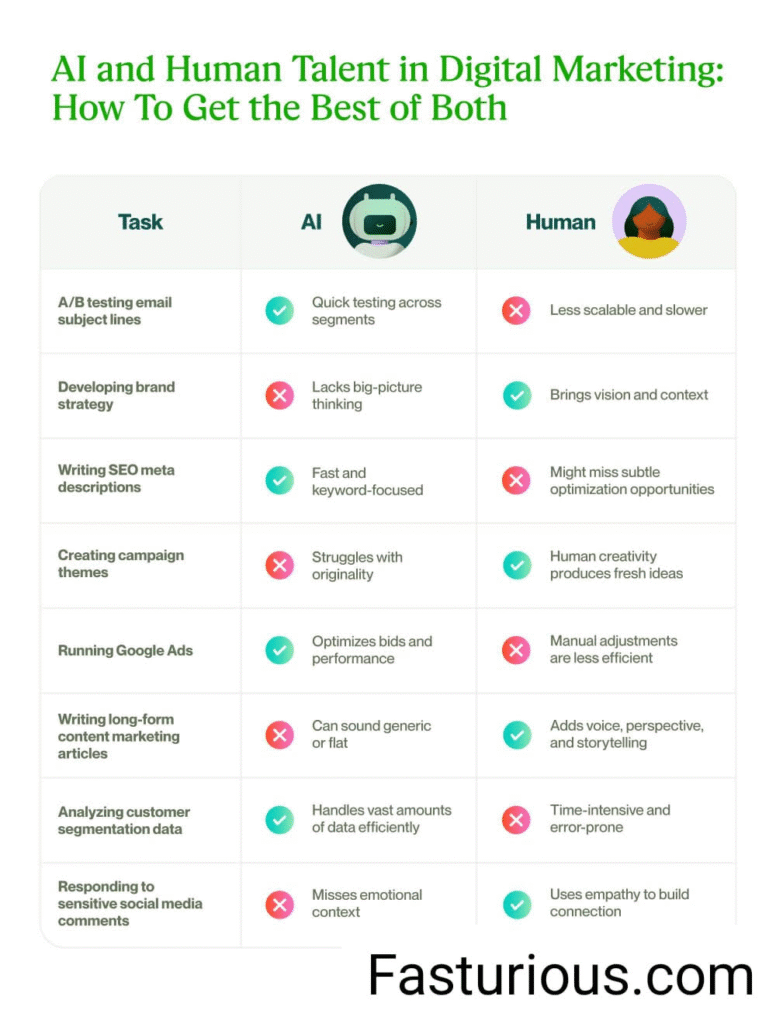
AI is a powerful tool in digital marketing, capable of speeding up workflows and improving efficiency. But when it comes to decision-making that involves creativity, strategy, or emotional nuance, human marketers still have the edge. The most effective marketing strategies in 2025 will combine both—using AI where it excels and bringing in human talent where it matters most.
Consider this quick-reference table to help decide when to lean on AI tools and when to prioritize the human touch:
Final Thoughts
AI has become the heartbeat of digital marketing in 2026, empowering brands to market smarter, not harder. Businesses embracing AI are not just adapting—they’re leading the future.
Whether you’re a marketer, entrepreneur, or content creator, the message is clear
AI isn’t replacing you—it’s upgrading you.
Author’s Note
As we step into this AI-driven marketing era, staying ahead means learning, adapting, and innovating faster than ever before.